
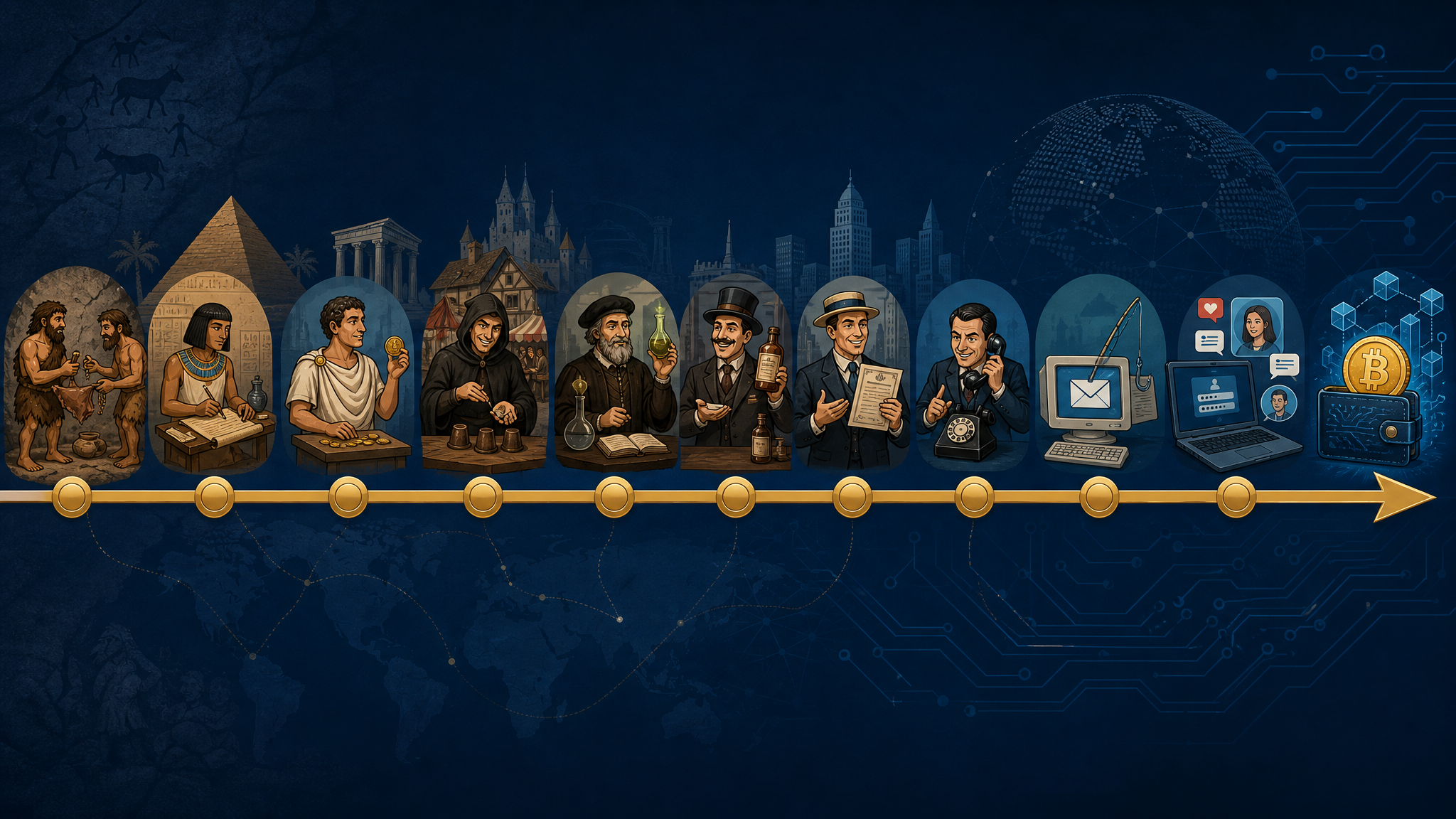
We Built a 12-Era Scam History Timeline in 30 Minutes With AI
By Carlos Cabrales • AI & Automation • May 13, 2026
My dad asked for scam history sketches for his senior community program. He needed visuals — something to walk older adults through how scams have evolved from ancient times to today.
30 minutes later, he had 12 custom illustrations, an interactive timeline website, a 60-second video slideshow, and a full narration script.
Not a proposal. Not a plan. Finished deliverables.
Here is exactly what we built and how.
What We Built
My dad runs a cyber safety program for seniors. He needed materials that would make scam history tangible — not a wall of text, but something visual, interactive, and memorable.
Here is what the CC3PO village delivered in under 30 minutes:
12 AI-Generated Cartoon Sketches
One illustration for each era of scam history, from cavemen bartering fake goods to crypto rug pulls:
 Era 1: Even cavemen were running scams. Fake barter goods — the original hustle.
 Era 2: Ancient Egyptians sold “magical” charms that were anything but.
 Era 3: Roman emperors debased coins — inflation by decree.
 Era 4: The Church sold forgiveness. Literally. Indulgences were the original subscription scam.
 Era 5: Alchemists promised to turn lead into gold. They just turned your gold into theirs.
 Era 6: Snake oil, miracle cures, and patent medicine — the original fake reviews industry.
 Era 7: Charles Ponzi gave his name to a scheme that never dies.
 Era 8: The telephone brought scams into your living room.
 Era 9: “I am a Nigerian prince.” Enough said.
 Era 10: Phishing turned your inbox into a minefield.
 Era 11: Social media made trust scalable — and scams scalable too.
 Era 12: Crypto rug pulls, AI deepfakes, and romance scams at scale. The future of fraud is already here.
Each illustration was generated, refined, and sized in minutes. Not stock photos — custom artwork tailored to the program’s educational tone.
Interactive Timeline Website
We didn’t just deliver images. We built a full interactive timeline at ccfamily.com/scam-history where visitors can click through each era, read the story behind the scam, and see the illustration alongside historical context.
A website. Not a PDF. Not a PowerPoint. A real, deployed, interactive website.
60-Second Video Slideshow
For presentations and social media, we generated a video slideshow cycling through all 12 eras with transitions. Ready to play at a community center or drop into a Facebook post.
Full Narration Script
My dad needed talking points. We generated a complete narration script — one paragraph per era — that he could read aloud during his program or record as voiceover for the video.
How We Built It (The Village Approach)
Here is the part most people skip over: how this happens in 30 minutes.
We did not use one chatbot. We did not sit at a desk typing prompts for half an hour.
The CC3PO village is a team of specialized AI agents that work in parallel. When my dad’s request came in, multiple agents grabbed different pieces of the project at the same time:
- Image generation agents created the 12 illustrations simultaneously — not one at a time, all at once
- A web development agent built and deployed the interactive timeline site
- A content agent wrote the narration script
- A video agent assembled the slideshow from the generated images
That is the difference between “using AI” and having an AI system. One chatbot works sequentially. A village works in parallel.
This is what AI built RIGHT looks like. Not chatbots. Not prompts. Real deliverables that help real people — in this case, seniors learning to protect themselves from scams.
The Lesson
My dad is not a tech person. He runs a community program that helps seniors stay safe online. He does not care about AI models or prompt engineering. He cares about having materials that work.
In 30 minutes, he went from “I need some sketches” to a complete educational package — illustrations, website, video, script. That is not a chatbot answer. That is a systems output.
The lesson: When you architect AI as a system — with specialized agents, parallel execution, and real deliverables — you stop asking “how do I use AI?” and start asking “what do I want built?”
The answer to that question is only 30 minutes away.
Want Something Like This for Your Business?
What we built for my dad’s senior program is the same approach we bring to every business we work with. The village does not just generate text — it produces real deliverables: websites, compliance systems, automated workflows, monitoring dashboards, content pipelines.
The Intelligence Architecture Audit shows you exactly what your business could be producing with the right system in place. We map your current workflows, identify what can be automated, and build a roadmap that turns manual tasks into village-powered outputs.
Book your audit → cc3po.com/intelligence-audit

Join the Discussion
Have thoughts on this article? Share them below. Comments are powered by GitHub Discussions.